Tampilkan postingan dengan label insurance. Tampilkan semua postingan

Selasa, 16 Oktober 2012

Your Job or Your Health Insurance

The signature achievement of President Obama's four years of office was the passage of the Patient Protection and Affordable Care Act, a.k.a. "ObamaCare". Passed into law in 2010, and initially upheld as constitutional by the Supreme Court in 2012, ObamaCare has had an ongoing negative effect upon the employment situation in the United States since it was crammed through the House of Representatives and the Senate solely by members of the Democratic party.

Unfortunately for Americans, the ObamaCare job killing spree will only continue and get worse. The reason why has to do with a penalty tax that will be imposed upon all U.S. employers with 50 or more employees who currently provide their employees with what would be considered to be an "average" health insurance coverage plan today.

The Manhattan Institute's Diana Furchtgott-Roth explains how that works:

... if an employer offers insurance, but an employee qualifies for subsidies under the new health care exchanges because the insurance premium exceeds 9.5 percent of his income, his employer pays a penalty of $3,000 per worker. This combination of penalties gives a business a powerful incentive to downsize, replace full-time employees with part-timers, and contract out work to other firms or individuals.

The new law will make it harder for small businesses with 50 or more employees to compete with those with fewer than 50 employees.

When the employer mandates are phased in 2014, many businesses will be motivated to reduce the number of locations and move workers from full-time to part-time status. This will reduce employment still further and curtail the country’s economic growth.

Let's get a sense of how many people that might affect. Today, over 90 million Americans, or 75% of all working Americans, are employed by firms that have 50 or more employees. With the average annual cost of employer-provided health insurance premiums for Single coverage set at $5,615, employers will only avoid ObamaCare's employer penalty head tax of $3,000 for their employees who earn more than $59,105 per year.

That's well above the $39,372 that represents the median income earned by Americans employed full-time, year round in 2011.

Why ObamaCare will cost you your job or your health insurance

What that means is that MILLIONS of Americans are going to be affected as ObamaCare adds directly to what it costs for their employers to have them on their payrolls.

And since President Obama hasn't done anything for the thousands of businesses that will be stuck with a higher cost of doing business without the additional revenue to pay for it, that means employers are going to have to consider one of the following options:

  1. Reduce the size of their business to employ fewer than 50 workers to avoid the tax.

  2. Cut the hours of their full time employees with lower incomes to make them part time employees to avoid the tax.

  3. Stop providing health insurance coverage for their employees.

  4. Keep providing health insurance coverage for their employees and take the hit to their bottom line, risking their ability to stay in business.

  5. Provide employees with "cut-rate" health insurance coverage that is inferior to their current health insurance coverage.

  6. All or some of the above.

One way or another, ObamaCare will negatively affect your job or your health insurance.

Previously on Political Calculations

Kamis, 06 September 2012

Enabling Disability Fraud - Part 2

Americans Receiving Social Security Benefits, January 1967 through June 2012

Today, we're going to demonstrate that the policies of multiple agencies of the U.S. federal government are responsible for enabling criminal disability fraud in the United States, with the cost of the fraud accelerating the pending insolvency of Social Security's Disability Insurance Trust Fund, which will put the program's legitimate beneficiaries at high risk of having their benefits cut after the fund has been exhausted.

Current projections indicate that the Social Security trust fund for disability will be fully depleted in 2016, just four years from the present. The projections from the previous year had indicated that would not happen until 2018. The large shift in the timing of the projected trust fund depletion toward the present in just a year's time indicates a strongly deteriorating fiscal situation for the government "safety net" program.

In Part 1 of our series, we discovered that the U.S. Social Security Administration has effectively established a "no-challenge" policy for disability insurance claims made by applicants over the age of 50, which allows these individuals to obtain Social Security disability benefits far more easily than individuals Age 49 or younger. This arbitrary policy is what enables these individuals to receive Social Security disability insurance payments, even though they might not otherwise be able to obtain those benefits if they were held to the same standards as those under Age 50.

Increase in Number of Social Security Disabled Workers from Previous Year's One Year Younger Age Group, 2005-2011

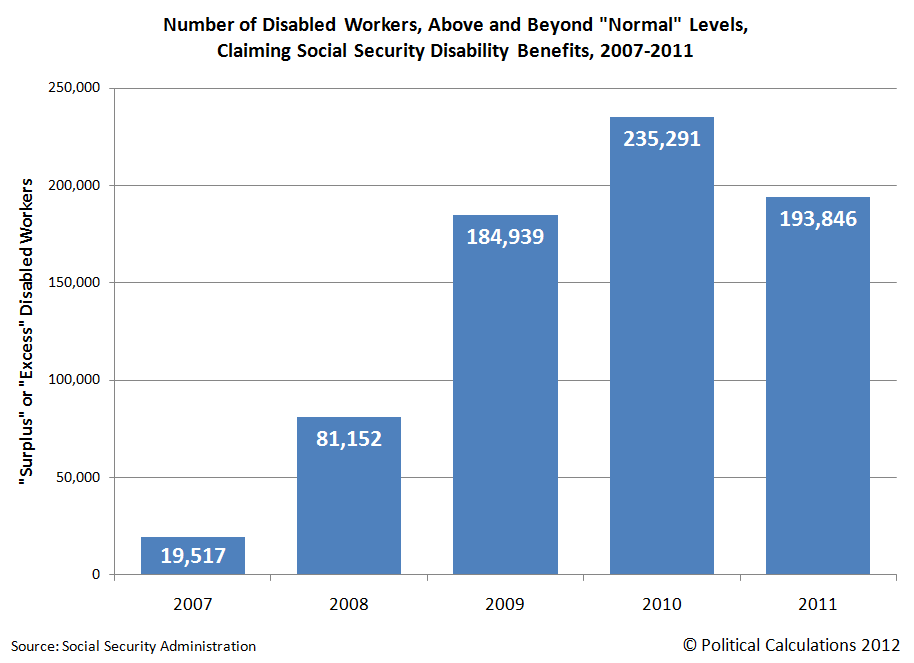
We observe the likely greater incidence of disability fraud as we more closely examine the surge in the number of Social Security disability beneficiaries in the years since 2007, which coincide with the Great Recession. Here, we found that approximately 695,000 more individuals have been added to the nation's government disability rolls during this time than the level that would be consistent with those of pre-Great Recession years.

Number of Disabled Workers, Above and Beyond

The chart above, showing the number of "surplus" or "excess" Social Security disability beneficiaries added in each year since 2007, indicates that the recession is the driving factor behind the increased number of individuals obtaining government disability payments, as the timing of the surge coincides with the expiration of government unemployment insurance benefits for individuals who were negatively impacted by the economic contraction, which officially ran from December 2007 through June 2009. The nation's sluggish economic recovery accounts for the decline in the number of surplus or excess Social Security disability program beneficiaries measured in 2011.

That connection between unemployment insurance benefits and disability insurance benefits brings us to where outright fraud is taking place today:

As many as 117,000 Americans simultaneously collect unemployment benefits and federal disability each year, a form of double-dipping that investigators say costs taxpayers $850 million annually and should be ended.

To understand why such "double-dipping" constitutes fraud, please note the following general requirements for each program:

  • To receive unemployment insurance benefit payments, claimants must state that they are able to work.

  • To receive disability insurance benefit payments, claimants must state that they are unable to work.

While there can be some small overlap in the detailed eligibility requirements for these programs that would legitimately allow a handful of individuals to receive benefits from both simultaneously, the vast majority of individuals currently receiving both unemployment insurance benefit payments and disability insurance payments do not fall within that narrow category and are therefore committing acts of fraud. In general, legitimate beneficiaries of these social safety net programs can draw funds from one program, or the other, but not both at the same time.

That multiple government agencies are involved in enabling this form of fraud is confirmed because the U.S. Department of Labor is responsible for administering the unemployment insurance program, while the Social Security Administration administers the Disability Insurance program. But worse than that is the reason why the fraud has been allowed to continue:

The reason for the double-spending, investigators at the Government Accountability Office reported this week, is good old-fashioned lack of communication.

Put simply, the Labor Department that funds unemployment benefits and the Social Security Administration that funds disability payments don't compare notes, leavings tens of thousands of Americans each month to collect two checks from a stretched-thin government treasury.

It would seem that the bureaucrats and politicians who are responsible for overseeing these programs learned nothing from the failure of government agencies to share information among themselves that enabled the criminal terrorist murders of 2,996 Americans on 11 September 2001 to proceed unchallenged.

This time however, the Government Accountability Office's report indicates that the annual savings that might be realized by ending this kind of fraud adds up to $850 million.

That's a savings of roughly 1 dollar out of each $1400 that is currently projected to be consumed in the nation's projected deficit of 1.21 trillion dollars for 2012! And it would be painless, because the people who are honestly playing by the rules would not be affected!

This is exactly the sort of thing that should be a no-brainer for a fiscally responsible politician - it's as close to low-hanging fruit as there is to be found anywhere in the U.S. federal government's budget. We wonder if any political candidate will rise to the occasion of acting to end the government's practices and policies that enable such costly fraud.

Selasa, 28 Agustus 2012

The Recession And Social Security Disability

Picking up on recent comments by Russ Roberts on the changes in the disability rolls over time, we thought we might revisit Social Security's data on the number of disabled workers collecting disability benefits for the years corresponding to the Great Recession. Beginning with the pre-recession baseline year of 2005, our first chart today shows the number of disabled workers counted as receiving Social Security disability insurance benefits for each year through 2011:

Age Distribution of Social Security Disabled Workers, 2005-2011

Here, we note that most of the change in the number of disabled workers from year to year is concentrated in older individuals, mostly Age 46 or older. We also note the moving peak of the leading edge of the Baby Boom generation from year to year, which we see shift from Age 58 for 2005 up to Age 64 in Age 2011.

In our next chart, we've extracted the net change in the number of disabled workers receiving Social Security disability insurance benefits from year to year, which we did by subtracting the previous year's number of disabled workers for the one-year-younger age group from the indicated age group:

Increase in Number of Social Security Disabled Workers from Previous Year's One Year Younger Age Group, 2005-2011

This chart shows how many disabled workers were added to the number of Social Security disability benefit recipients with respect to the previous year's one-year-younger age group.

Here, we note that there is a distinct spike in disabled workers receiving Social Security disability benefits at Age 50, regardless of each year's economic climate. Here, we earlier found that this corresponds to the Social Security Administration's policy of not seriously challenging the disability claims of workers Age 50 or older.

But perhaps more importantly, in looking at the year-over-year change from 2005 to 2006 (identified as 2006 in the chart) and the year-over-year change from 2006 to 2007 (identified as 2007 in the chart), we find that the year-over-year change for these two pre-recession years are almost identical. This gives us a very good baseline from which we can determine the extent to which the Great Recession has influenced the number of individuals successfully claiming disability benefits in subsequent years.

That result is shown in our third chart, in which we've counted the number of surplus or excess disabled workers added to the number of disability claims in each year from 2007 through 2011 with respect to the net change recorded for each indicated age in 2006:

Change in Number of Social Security Disabled Workers from Net Change Recorded in 2006, 2007-2011

Adding up the values for each indicated age for each year, we find the number of surplus or excess disabled workers, or rather the number of disabled workers above and beyond what would be considered "normal" and might therefore be attributed to the Great Recession, were added to the disability rolls in the years from 2007 through 2011:

Number of Disabled Workers, Above and Beyond

Altogether then, we estimate that some 695,228 individuals, above and beyond the numbers that might be considered to be normal, have filed for and received Social Security disability insurance benefits in response to the Great Recession in the years from 2008 through 2011. We also note that the timing of the increase in the disability rolls would correspond to when many of these individuals would have exhausted their unemployment benefits, suggesting that going on disability became an alternative to seeking gainful employment for these individuals.

And that's a big reason why Social Security's Disability Insurance Trust Fund is now projected to be fully depleted in less than four years time.

Data Sources

Social Security Administration.

Disabled worker beneficiaries in current payment status in December of indicated year, distributed by age and sex. 2005, 2006, 2007, 2008, 2009, 2010 and 2011. Accessed 27 August 2012.