Tampilkan postingan dengan label geek logik. Tampilkan semua postingan

Jumat, 14 Juni 2013

When Should You Stop Shopping and Start Buying?

Shopping - Source: atg.wa.gov You know how it is when you're out shopping. You're looking for the perfect thing, but you're not finding it. In that situation, how long should you keep at it?

Notice that we didn't mention what it is that you might be shopping for.

The truth is that it doesn't matter - we could be talking about anything from apartments for rent to engagement rings made from the finest cubic zirconium, and possibly even your future spouse, and unless you're fortunate enough to recognize perfect when you've somehow accidentally stumbled across it, what you're really shopping for is something that's just good enough to meet your needs.

And to find it, it turns out that you just need to know how much shopping you're willing to commit to do before you've seen enough and can simply buy the next best thing you see.

Emily Oster recently addressed this problem in taking on a question from a young couple seeking a new place to live, but not as yet having much luck in finding suitable accommodations. She writes:

You have, perhaps inadvertently, happened upon an extremely famous area of statistics: optimal stopping theory. The classic example is the secretary problem: you want to hire a secretary, and you have many applicants you interview in order. How do you know when to stop interviewing and hire someone? In your case, how do you know when to stop viewing apartments and just rent one?

Part of what attracts statisticians to this problem is it turns out to have an extremely elegant solution. First, figure out how many apartments you expect to see. Let’s say you think you’ll see 50. The solution says that you should reject the first 50/2.71 apartments (or, about the first 20 of them) and then rent the first one you see after that which is better than any you’ve seen before. (For those of you following the math, the precise number you reject is 50/e, the base of the natural log.)

This is pretty easy to follow and statisticians have proved it will get you the best apartment about 40% of the time, which definitely isn’t 100% but is better than any other strategy!

Well, with that kind of statistical endorsement, how could we possibly pass up the opportunity to build a tool to do the math for you? Just enter the total number of possibilities that you're willing to consider in your search to find what's just good enough for you, and we'll determine the minimum number of possibilities you need to consider to make a decent decision!


Number of Possibilities to Consider
Input Data Values
Maximum Number of Choices for Your Shopping Search


The Optimal Stopping Point for Shopping
Calculated Results Values
Minimum Number of Choices to Consider to Make a Good Choice
If you're reading this article on a site that republishes our RSS news feed, click here to access a working version of this tool!

For our default example, in a search for where you would be willing to consider up to 50 possible options in your pursuit of the best choice for you, by the time you've considered at least 18 of them, you will have seen enough and can jump at the first opportunity you have that is better than all that you have previously seen.

And, for what it's worth, there's even a 40% chance that you'll be right. Happy shopping!


Kamis, 24 Mei 2012

Measure Your Happiness Level!

Smiley Face - Source: supercomputing.fnal.gov
We're not sure how we missed this bit of math previously, but scientists have worked out a math equation that may be used to quantify how happy you are!

No, we're not making this up! In fact, we've built a tool so you can calculate your current personal happiness level. Just answer the following questions by ranking yourself from 1 (not at all) to 10 (to a very large extent), and we'll do the rest....


The Factors of Happiness
Input Data [Rank Yourself for Each Question from 1 to 10] Values
Are you outgoing, energetic, flexible and open to change?
Do you have a positive outlook, bounce back quickly from setbacks and feel that you are in control of your life?
Are your basic life needs met, in relation to personal health, finance, safety, freedom of choice and sense of community?
Can you call on the support of people close to you, immerse yourself in what you are doing, meet your expectations and engage in activities that give you a sense of purpose?


How Happy Are You?
Calculated Results Values
Your Personal Happiness Level

And now you know exactly how happy you are right now, a least as might be quantified by some sort of a scientist on a scale from 1 to 100. If you'd like to adjust your happiness to a different level, you'll likely need to make some changes. The BBC's article suggests how that might work based upon your sex:

The researchers found that different factors were important for the different sexes.

Four in ten men said sex made them happy, and three in ten said a victory by a favourite sports team.

For seven in ten women happiness was related to being with family, and one in four said losing weight.

Romance featured higher for men than women. So did a pay rise and a hobby they enjoyed.

Women were more likely to cite sunny weather.

Ultimately though, it turns out to really be a matter of choice:

Ingrid Collins, a consultant psychologist at the London Medical Centre, told BBC News Online: "I would be very surprised if people sat down and had to work out whether they were happy or not.

"We can all be happy in a heartbeat if we make the decision to be so."

Indeed. And thank you for taking the time to sit down and work out whether you are happy or not with our tool!

Jumat, 23 Maret 2012

Will Your Favorite Celebrity Couple Stay Together?

Brain Trust - Source: Random House

Five years ago, Garth Sundem and John Tierney worked together to come up with a mathematical formula to predict which celebrity couples were doomed to split apart.


Five years later, that original equation did an okay, but not great job in predicting which celebrity couples would survive the next five years.


So Sundem and Tierney returned to the drawing board to take advantage of the new data the world had accumulated about the success of celebrity relationships over the previous five years, and have now come up with a new and improved mathematical formula that seems to work better, at least if the backtested results are any indication.


Here's what changed in their own words:


While the 2006 equation did a good job over all of identifying which couples were most likely to divorce, some of the specific predictions proved too pessimistic. Because Demi was so famous — and much more famous than Ashton — we gave their marriage little chance of surviving a year, but they didn't split until 2011. We were similarly bearish on Tom Cruise and Katie Holmes (because of his fame, his two failed marriages and their age gap), but they're still together.


What went right with them — and wrong with our equation? Garth, a self-professed über-geek, has crunched the numbers and discovered a better way to gauge the toxic effects of celebrity. Whereas the old equation measured fame by counting the millions of Google hits, the new equation uses a ratio of two other measures: the number of mentions in The Times divided by mentions in The National Enquirer.


"This is a major improvement in the equation," Garth says.


"It turns out that overall fame doesn't matter as much as the flavor of the fame. It's tabloid fame that dooms you. Sure, Katie Holmes had about 160 Enquirer hits, but she had more than twice as many NYT hits. A high NYT/ENQ ratio also explains why Chelsea Clinton and Kate Middleton have better chances than the Kardashian sisters."


More on the Kardashians later. For now, here's our newest tool, which is based on Sundem and Tierney's new and improved formula for predicting which celebrities are riding on the relationship Titanic.


Celebrity Relationship Factors
Input Data Values
"Good" Fame: Number of search results since 1990 in New York Times archives
"Bad" Fame: Number of search results since 1990 in National Enquirer archives
Husband's Age
Wife's Age
Overexposure: Number of scantily-clad photos among the top five photos returned in a Google image search for the wife's name
Dating: Number of months the celebrity couple dated before getting married
Time: Years after getting married for which to calculate the percentage odds that the couple will still be married.


Odds of Celebrity Marriage Survival
Calculated Results Values
"Good" to "Bad" Fame Ratio
Percentage Chance of Still Being Married After Entered Number of Years


Tierney describes how these factors can influence the outcome of the new formula:


Garth's new analysis shows that it's the wife's fame that really matters. While the husband's NYT/ENQ ratio is mildly predictive, the effect is so much weaker than the wife's that it's not included in the new equation. Nor are some variables from the old equation, like the number of previous marriages and the age gap between husband and wife.


In the fine tradition of Occam's razor, the new equation has fewer variables than the old one. Besides the wife's tabloid fame, the crucial ones are the spouses' combined age (younger couples divorce sooner), the length of the courtship (quicker to wed, quicker to split), and the sex-symbol factor (defined formally as the number of Google hits showing the wife "in clothing designed to elicit libidinous intent").


Now, back to the Kardashians. The default data in the tool above apply to the celebrity coupling of Khloe Kardashian and Lamar Odom, with the results using this default data indicating the probability that the couple will celebrate their 50th wedding anniversary.


And from here, we'll let Garth Sundem describe the results:


"I've calculated the chance of Khloe Kardashian and Lamar Odom celebrating their golden anniversary," he says, "Even when I extend it to 15 decimal places, the probability is still zero."


To be fair, if any of the Kardashians could celebrate a 50th wedding anniversary, it probably would be Khloe. She'll just have to beat some very steep odds to do it though....

Kamis, 08 Maret 2012

Brain Trust

Mapping the Brain - NIH

Once upon a time, we were referred to as the "brain trust over at Political Calculations". From that moment on, we've always referred to ourselves as "we", not because we have some royal delusions of adequacy, but because we recognized that it was true. Political Calculations is a genuinely collaborative effort involving some of most intelligent and insightful people alive today, whose various contributions to the posts that appear here and elsewhere around the Internet ought to be acknowledged.


A lot of them are people who simply blogged about problems they solved in their everyday lives. Some of them are our regular readers, who asked some good questions that we couldn't resist answering. Others are among the top professionals in their fields. They make us possible!


The best part? Many of them have absolutely no idea who we are! And that's the way we like it, but if you must know more about us, you might start with our online profile, because it's all true....


Now, that's us, but what about you? What if you had your own brain trust, where you knew that everyone in it was truly one of the top people in their lines of work? People who have devoted years to what they do, and because they have, could answer almost any question you might ask them. Wouldn't that be pretty cool?


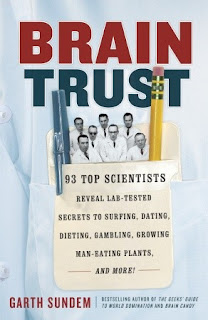
Brain Trust - Source: Random House

It so happens that Garth Sundem, for many practical purposes, "one of us", has assembled his own brain trust and asked them almost anything!


The results of that effort have now been published in the new book Brain Trust.


In it, Garth shares what he learned after asking some 93 scientists the secrets to things like how to surf better, how to grow a man-eating plant, how to go about bribing a police officer to get out of a ticket, and how to build a world-record paper airplane. Oh, and how to get a job, along with getting their dating and dieting tips!


And perhaps most intriguingly for some of our readers - which lotteries in the U.S. are worth playing?


But it's the people he asked who make up Garth's Brain Trust. They're not just your ordinary, everyday, run-of-the-mill scientists, but Nobel prize winners and MacArthur "geniouses". People who have been awarded real medals for science.


Who are they? Well, they're people with whom we might be collaborating someday or have already, so we won't say. If you really must know though, the book is available through Amazon.


Highly recommended. You can tell them that the "brain trust over at Political Calculations" said so!


Previously on Political Calculations


Tools and posts inspired by Garth Sundem's Geek Logik:


Our Reviews of Other Books by Garth Sundem


Selasa, 14 Februari 2012

Happy Valentine's Day!

Would you like to send your significant other a specially coded transmission for Valentine's Day?


If so, then yes, you're a complete geek. But then, they already knew that about you, didn't they?...


So what about this special Valentine's Day code? Well, first, here it is:

sqrt(cos(x))*cos(300x)+sqrt(abs(x))-0.7)*(4-x*x)^0.01, sqrt(6-x^2), -sqrt(6-x^2) from -4.5 to 4.5


Now, what you have your significant other do is enter it into Google for a special result. (Click here if you want to see it directly for yourself!)


The IBT's Kukil Bora explains how it works:


The series, including square roots, absolute values and cosine functions, will form the shape of a heart in deep blue. Twitter user @Huckberry shared the trick by posting it on his Twitter page.


Because of the absolute value function flipping the sign of the x-coordinate, the plotted lines change direction and form a mirror image diagonally the y-axis.


The "cos(300x)" part in the formula makes the line go up and down quickly. If the number "300" in the equation is changed to "100," it will show how the blue line traces out the interior of the heart - higher the number, higher the rate of frequency of the blue line, filling up the heart.


Previously on Political Calculations