Tampilkan postingan dengan label chaos. Tampilkan semua postingan

Selasa, 15 Oktober 2013

A New View of Future Expectations for the S&P 500

Now that Eugene Fama, Lars Peter Hansen and Robert Shiller have collectively been awarded the Economics Nobel prize for their insights into how asset prices work, insights that we both routinely apply and have extended in our own work, we'll take this opportunity to open up a new window for how all that applies to the S&P 500.

We'll do that by remaking our favorite chart - the one that shows how changes in the year-over-year growth rate of today's stock prices keep pace with changes in the year-over-year growth rates of the dividends per share that are expected at specific points of time in the future - replacing the dividend futures data we obtain from IndexArb with dividend futures data from the Chicago Board of Exchange, which are really different from one another. The chart below shows all that data for each future quarter's dividends going all the way from 3 January 2013 through 10 October 2013:

Change in Growth Rates of Expected Future Trailing Year Dividends per Share with Daily and 20-Day Moving Average of S&P 500 Stock Prices, through 10 October 2013

Each of the data series that apply for a future quarter's dividends per share represent the expectations that investors have for the amount of dividends they will earn in that quarter. In the absence of large sources of noise, or variance, changes in the growth rate of stock prices will closely track with the trajectories associated with a specific future quarter where investors collectively focus their forward-looking attention.

In the chart above, we see that's the case at the very beginning of 2013, where investors focused their attention on the expected future defined by the second quarter of 2013 in setting stock prices. The focus of investors remained on that quarter, which ended in June 2013, well into April 2013.

At that point, investors began shifting their forward-looking attention to the more distant future defined by the expectations for dividends associated with the first quarter of 2014. We observe this shift in focus in the transition of daily stock prices (the dotted blue line) from the data series for 2013-Q2 to 2014-Q1.

That attention stayed there until 19 July 2013, when stock prices suddenly deviated from where investors were focused in response to what we've called the Bernanke Noise Event. Here, investors reacted to the new information that Fed Chairman Ben Bernanke communicated at a press conference that the Fed was seriously considering tapering off its purchases of government-issued securities once certain economic targets were hit by sending stock prices considerably lower than they would otherwise have been set if only the expectations of future dividends to be paid in 2014-Q1 were driving them.

That reaction was more than the Fed was ready to handle at that time. It took a month of effort, but the Federal Reserve finally succeeded in restoring the expectation that investors previously had that there would be no tapering of its QE programs until 2014, which we observe in stock prices resuming to closely track the expectations for 2014-Q1's dividends. But then, positive economic data combined with statements by lesser Fed officials led investors to believe that the Fed could begin tapering its QE program before the end of the third quarter of 2013.

That set off a larger negative reaction in stock prices. Only here, investors shifted their focus away from the more distant future quarter of 2014-Q1 in setting stock prices to instead fully focus on the critical quarter of 2013-Q3. We observe that shift taking place from the end of the Bernanke Noise Event through the end of August 2013, which marked the high point for the expectation of investors that the Fed would being tapering its QE programs in September 2013.

And then, the real-time economic outlook for the U.S. economy began to take a turn back to the worse, leading investors to increasingly bet that the Fed would not act to cut back its QE programs at the end of 2013-Q3, which led to rising stock prices as investors refocused their attention toward 2014-Q1. The Fed then surprised many, including us, that it would not act in 2013-Q3 to trim its QE bond-buying spree, but in retrospect, the evidence from stock prices and the expectations for future dividends supports that interpretation of events.

Unfortunately, before they could make it back to the level that would be fully consistent with the expectations associated with 2014-Q1, a new negative noise event centered around the potential for a government shut down and partial default on the nation's debt reared its ugly head, causing stock prices to once again deviate away from the level they would otherwise be. And that brings us nearly up to the present.

If all this makes the stock market sound like a chaotic place, that's because it frequently is - but that doesn't mean there isn't a predictable order underlying it all. That's what lies beyond the work of newly-minted Nobel-prize winning economists Fama, Larsen and Shiller, whose work has made what we do possible.

Speaking of which, if you want to find out more about our work, it all begins here. You only have to review several years of worth of what we've worked out live, in real time, without the benefit of any sort of safety net to catch up to us!...

Notes: we've modified the chart in this post from previous versions by eliminating an additional scale factor of 12 that we were applying to both the changes in the growth rates of dividends and the change in the growth rate of stock prices, which was an artifact our annualizing the monthly data we were using when we first discovered the relationship between the two. Since this additional scale factor is applied to both dividends and stock prices, it effectively cancels out of our math describing how changes in the growth rates between the two are related, so we're taking this opportunity to dispense with it altogether.

Beyond that, we've also changed our amplification scale factor, which is the scale factor that matters in our math. This change was driven by our change in data sources, where there can be considerable differences between the dividend futures data reported by IndexArb and that reported by the CBOE. Using IndexArb's data, we had settled on a typical amplification scale factor of 9.0, while the factor we're opting to use for the present with the CBOE's data is 5.0.

Kamis, 19 September 2013

The Fed's Surprising Decision and Its Next Decisions

Yesterday's announcement by the Federal Reserve that it will not begin reducing its purchases of U.S. Treasuries and mortgage-backed securities with newly created money (a.k.a. "Quantitative Easing" or simply, QE) was a surprise.

Or was it really?

You would have to count us among those who were surprised that the Fed decided to hold off on trimming its $85 billion per month on average security-buying spree. We fully expected that the Fed was going to announce that it would reduce its pace of acquisitions by somewhere between $10 and $20 billion per month, which we base on our assessment that the U.S. economy has finally begun to recover from a year-long microrecession.

But was it really a surprise to all investors across the board?

The reason we ask that question is because the unique measure of probability that we developed specifically to determine how likely that investors collectively believe that the Fed might announce that it would reduce its QE purchases this month, rather than in 2014, has been sending a very different signal for weeks:

Investor-Assessed Probability that the Federal Reserve Will Begin Tapering Its QE Programs in 2013-Q3 or 2014-Q1

As we can see in the chart, our estimated probability that the Fed would taper sooner peaked at 78% (with a typical margin of error of +/- 15%) on 31 August 2013. Since then however, that probability has itself tapered off, and going into 18 September 2013, the day of the Fed's announcement, it had been cut nearly in half to 42%.

We had interpreted that decrease as being consistent with investors shifting their forward-looking focus for setting their expectations for stock prices to the more distant future. We reasoned that since there was so little time left in 2013-Q3, there was little point for investors to continue speculating on the future of the Fed's QE program, since the clock was ticking down on both when the Fed would make its announcement and the effective end of the quarter (the dividend futures contracts for 2013-Q3 expire this upcoming Friday, 20 September 2013).

We reckoned that investors were shifting their attention to the first quarter of 2014 in setting their expectations for making their investment decisions. And paradoxically, that's exactly the same outcome we would expect for a future where the Fed would choose to delay trimming back on its QE program.

So what if a number of influential investors had instead come to the conclusion that the Fed would sustain its current pace of security acquisitions for its QE program? Anticipating the upward market move that would accompany such a policy adjustment, could they have been buying up stocks at comparatively low prices in advance of the announcement, driving up stock prices in such a way that they were really communicating that the Fed would keep the status quo with its QE program?

We don't know if we'll ever find out the answer to that one, except perhaps by how much profit-taking now takes place over the next few weeks now that the Fed's announcement is behind us. It's just a good thing that one way or another, the market was shifting to focus on the future as defined by 2014-Q1, which has meant, and will continue to mean, generally rising stock prices in the absence of a significant level of new noise in the market.

Speaking of which, the leading contender for a new negative noise event at this time would be a partial federal government shutdown sometime in October 2013. That potential perhaps explains why the Fed opted to continue its program, since it has already proven itself to be capable of offsetting bad and ineffective fiscal policies emanating from Washington D.C.

And if the Fed really wanted to send a message to the people in Washington D.C. who really need to receive it, it would act to boost its QE efforts by 60% of the amount that federal government spending would be reduced in the event of such a partial government shutdown, since this additional amount of QE would be sufficient to completely offset the negative fiscal drag on the nation's GDP that would result from such a partial shutdown.

After all, there's really no good reason to put the rest of the American people through any more economic hardship because of poor fiscal policies emanating from Washington D.C. At long last, perhaps its time for the politicians and bureaucrats to pay the price for their bad behavior, and the best way to target them is to let them go through the kabuki theater of a government shutdown, but to offset it with enough QE so that regular Americans would be hardly affected by their actions.

Is there anything worse for a politician or a bureaucrat than finding out that they don't have the power they think they do? In this case, would there be any better public service that the Fed could perform for the American people?

Senin, 16 September 2013

S&P 500 Expectations: Back to the More Distant Future

As we expected, with the Federal Reserve's tapering of its current QE programs now a near certainty, investors have begun shifting their attention to a more distant future quarter.

More specifically, they're shifting their attention away from 2013-Q3, the quarter that investors have associated with the Fed acting to begin reducing the pace of its acquisitions of U.S. Treasuries and Mortgage-Backed Securities, back toward 2014-Q1.

Change in the Growth Rates of Expected Future Trailing Year Dividends per Share with Daily and 20-Day Moving Average of S&P 500 Stock Prices, through 13 September 2013

Compared to the previous version of this chart, the path of daily stock prices, as indicated by the dashed blue line, is now moving rapidly away from the expectations of the change in the growth rate of future dividend income associated with the current 2013-Q3 quarter back toward the expectations associated with 2014-Q1.

Hourglass - Source: http://www.blm.gov/ut/st/en/prog/more/cultural/Paleontology/Paleontological_Permitting/blm_ut_permittees.html

There's more to this transition than just the locking-in of the expectation that the Fed will taper its QE programs sooner. We're also running out of future for investors to focus upon in 2013-Q3 as well!

By that, we mean that for all practical purposes, the future left to run in 2013-Q3 will run out this upcoming Friday, 20 September 2013, as the dividend futures contracts for 2013-Q3 are set to expire on that date. Since last week, there is very little benefit left for investors to continue shaping any portion of their investment decisions based upon the expectations related to 2013-Q3.

As a result, instead of being 74% of the way from 2014-Q1 (0%) to 2013-Q3 (100%) on our chart, daily stock prices (the dashed blue line) have risen to be just 49% of that distance. In the absence of any major new noise events, we would anticipate that stock prices will continue to generally rise as investors fully refocus their forward-looking attention on this quarter.

There is one wild card we haven't mentioned on our chart above. With the expiration of the dividend futures contract for 2013-Q3, we'll soon have that data replaced by that for the futures contract of 2014-Q3. It's possible that investors might focus upon that quarter, but we believe unlikely at this time, as it would make more sense for investors to focus on the nearer term that would coincide with the period of time in which most companies would implement any major changes in their dividend policies related to changes in their future business outlook.

Update 16 September 2013, 9:10 AM EDT: As a side note, we wrote this analysis on Friday, 13 September 2013, long before the news of Larry Summers withdrawal from consideration became news on the afternoon of Sunday, 15 September 2013. Shortly after the news came out, we posted our thoughts on how the market would react to Summers' withdrawal on Monday over at Barry Ritholtz' blog, before the stock price futures for 16 September 2013 came out - it would seem all is going as we expected....

Selasa, 10 September 2013

The Evolution of Investor Expectations for the Future of QE

What we're about to show you is only possible because of the work we've done to describe how stock prices change in response to the changes in the fundamental factor that drives them: expectations of the amount of cash dividends per share that will be paid out to investors in the future. Because we are able to isolate the effect of this fundamental driver on stock prices, we can determine the extent to which they respond to other, non-fundamental factors.

Typically, we would describe these non-fundamental factors as "noise", because they contribute to the apparently random variation of stock prices over time, mainly as investors react and sometimes overreact to new information. Most often, there are multiple sources of noise that affect stock prices, which makes the stock market a pretty noisy place, even in typical circumstances.

Meet Your Expectations - Source: coolspot.gov

But sometimes, there is a single source of noise that is so "loud" that it seriously skews stock prices away from the levels that they would otherwise be if we went just by their fundamental drivers. The expectation of what the Fed will do with its Quantitative Easing (QE) programs and when it will do it is just such a loud source of noise.

The reason why that's the case is because the Fed's latest QE effort is fully responsible for virtually all of the nation's economic growth since the third quarter of 2012. Since the Fed's latest QE program was first announced in September 2012, the Fed has effectively put the tab for overcoming all the fiscal drag from minor government spending cuts and major tax hikes and all of the positive economic growth in the nation's GDP above its 2013-Q3 level on its balance sheet through its QE programs.

Clearly then, what happens with the Fed's QE programs is of great interest to investors, because of their effect upon investments. It really shouldn't be any surprise that they have reacted whenever there has been any inkling of a potential change in what the Fed will do with those programs.

Our chart below shows how they have reacted to all the news and noise related to those potential changes, using the expectations for the future dividends per share for the S&P 500 that will be paid by the end of 2013-Q3 and 2014-Q1 as the fundamental benchmarks against which we can measure the changing expectations related to the future for the Fed's QE program.

Investor-Perceived Probability that Fed will begin Tapering Its QE Programs in 2013-Q3 vs 2014-Q1, 1 May 2013 through 9 September 2013

In the chart above, a 0% reading indicates that investors are fully focused on 2014-Q1 in setting their expectations for buying and selling stocks, which also coincides with the expectation that the Fed would not change their QE program until 2014. By contrast, a 100% reading would be an indication that investors have fully shifted their attention to 2013-Q3, which corresponds to the expectation that the Fed will begin drawing down its QE program in that quarter.

Generally speaking, an increase in the probability of an early tapering for QE shown in the chart above coincides with a decrease in stock prices.

Now let's match up the action on the chart with history. The word that the Fed might begin scaling back the purchases of the mortgage-backed securities (MBS) and U.S. Treasuries that make up the core of its QE programs first came in early May 2013. At the time, stock market investors were transitioning their forward-looking focus for the dividends per share they expect to earn from the second quarter of 2013 to the first quarter of 2014, so that news was not paid much attention as they shifted their focus to a new set of expectations for the future in deciding how much of which stocks to buy or sell.

So they didn't put much stock into the possibility that the Fed might trim back its MBS and Treasury buys before the end of 2013 at the time. It was a trivial consideration as investors were focusing in on a new set of expectations for the future where their investments were concerned, and any effect that it might have had on stock prices was lost in the typical level of noise in the market.

By mid-May, the forward-looking focus of investors was squarely set on the expectations associated with the first quarter of 2014. The economic situation in the U.S. was such that it seemed unlikely that the Fed would consider changing its QE programs until that point at the earliest, so stock prices behaved accordingly.

The stock market got a wake up call at 2:42 PM EDT on 19 June 2013. That was nearly the exact moment when Federal Reserve Chairman Ben Bernanke put his voice behind the idea that the Fed would act to reduce its QE efforts before the end of the year if the economy improved as the Fed expected, and perhaps as early as before the end of the third quarter of 2013. Stock prices quickly plunged as a number of investors began making buy and sell decisions based upon the expectations associated with the third quarter of 2013.

Trying to Get the Genie Back in the Bottle - Source: California Bar Journal

The Fed wasn't ready for that expectation to take hold, since the data for the nation's economic performance wasn't good enough to support that conclusion at that time, so the Fed spend the next month doing everything in its power to put the QE-tapering genie back in its bottle. And they succeeded, which we see in the probability level falling back to the near-zero level.

But then, the nation's economic data began indicating improvement, and combined with the losses the Fed is taking on its balance sheet from buying into the MBS and Treasury markets at and near their respective tops, began providing Fed officials with the incentive to push for an earlier end to QE, even though the nation's economic situation is still such that the change in policy may be premature and heaven forbid that the Fed ever realize a loss on its own books....

Since then, the probability that the Fed would reduce its MBS and Treasury buys rose until it peaked in the last week.

Since we're now less than two weeks away from when the dividend futures contract for the third quarter of 2013 expires, there is little reason for investors to continue dwelling upon when the Fed will actually taper its QE program, especially when it's clear that a consensus has been made. With the time left in the quarter running out, there is too little advantage at this point for investors to even bother with the Fed's short-term plans for QE, unless they're drastically different from what they've indicated would be the case.

Instead, we think that it is more likely that investors will once again shift their forward-looking focus back to the expectations associated with the first quarter of 2014 in deciding what to do with their investment portfolios. If that's the case, based just on the fundamental driver for stock prices, it's a time to buy while stock prices are lower than they will be.

That doesn't consider the effect of new sources of noise that might negatively affect the outlook for investors. With a potential attack on Syria, a potential U.S. government shutdown in October and the potential for the Fed's officials saying or doing something really stupid, just to name a few possibilities being tossed around the news today, there's plenty of noise out there to make investing in the stock market the risky short term affair that it always is.

The key thing to understand about noise however is that it always ends - it is only ever a question of when. And with the immediate future for the Fed's QE program, we're very near the end of its current act.

Senin, 09 September 2013

S&P 500: Shifting Expectations, Shifting Stock Prices

Last week provided a pretty neat example of how changing expectations of dividends that will be paid in the future cause today's stock prices to change in response.

Our first chart shows how the expectations for the equivalent amount of dividends per share for the S&P 500 that are expected to be paid out in the first quarter of 2014 changed from Friday, 23 August 2013 through Wednesday, 4 September 2013 (when we created the following chart), along with the change in the closing value of the S&P 500 index on each day:

Change in Expectations for 2014-Q1 Dividends and Change in S&P 500 Index Value, 23 August 2013 through 4 September 2013

The scaling was automatically selected by Microsoft Excel when we created the chart - we haven't done anything to tweak it.

In looking at the chart, we see that the expectations for future dividends per share changed first on Monday, 26 August 2013, dropping by 11 cents per share, and was proportionately followed a day later by S&P 500 stock prices, which dropped by $33 per share. On Wednesday, 4 September 2013, we see that the expected dividends per share for the quarter suddenly jumped higher, as stock prices followed suit on the same day, but did not jump as high.

That's likely because of the effect of another set of expectations that is currently affecting stock prices. In addition to their fundamental driver of expected future dividends per share, stock prices today are also being greatly affected by investor expectations for the Federal Reserve's current program of quantitative easing.

Here, we observed last week that investors were effectively giving anywhere from a 62% to a 78% probability that the Fed will announce that it will begin purchasing fewer U.S. Treasuries and mortgage-backed securities before the end of the third quarter of 2013. (Note: we believe the actual probability is much closer to the high end of that range - the lower probability is given by one of our sources for expected future dividends per share that was set in place nearly three months ago.)

But when we did the same analysis this week for estimating that likely probability, which we by determining the percentage of the distance between the expectations for dividends are in the relevant future quarters are with respect to with the change in the growth rate of daily S&P 500 stock prices, we find that even though the future expectations for 2014-Q1 changed, investors maintained the nearly the exact same expectations for when the Fed might begin tapering its current QE programs:

Change in Growth Rates of Trailing Year Dividends per Share with Daily and 20-Day Moving Average of S&P 500 Stock Prices, through 6 September 2013

As a result, stock prices maintained the same relative position between the future expectations for dividends per share in 2013-Q3 and 2014-Q1, indicating a 61%-74% probability that the Fed will indeed begin tapering its QE program in 2013-Q3. (Note: We would still say that Schrödinger's Cat is three-quarters dead.)

So, while fundamental expectations of the future changed, expectations related to the Fed's QE program did not. The combination of these factors largely explains and accounts for how and why stock prices as measured by the S&P 500 have changed just as they have since 23 August 2013.

Senin, 26 Agustus 2013

Schrödinger's Cat and the S&P 500

What a boring week!

The week ending on 23 August 2013 was a week in which the Fed's officials very clearly went out of their way to not make any noise as they jetted off to Jackson Hole, Wyoming for their annual retreat. And in the absence of other noise or significant changes in the fundamental outlook for the companies that make up most of the U.S. stock market, the market pretty much ended exactly at the same level it ended in the previous week.

Really! To illustrate the point, we added just two words to our notes on our chart from last week. Actually, just the same word twice "Still":

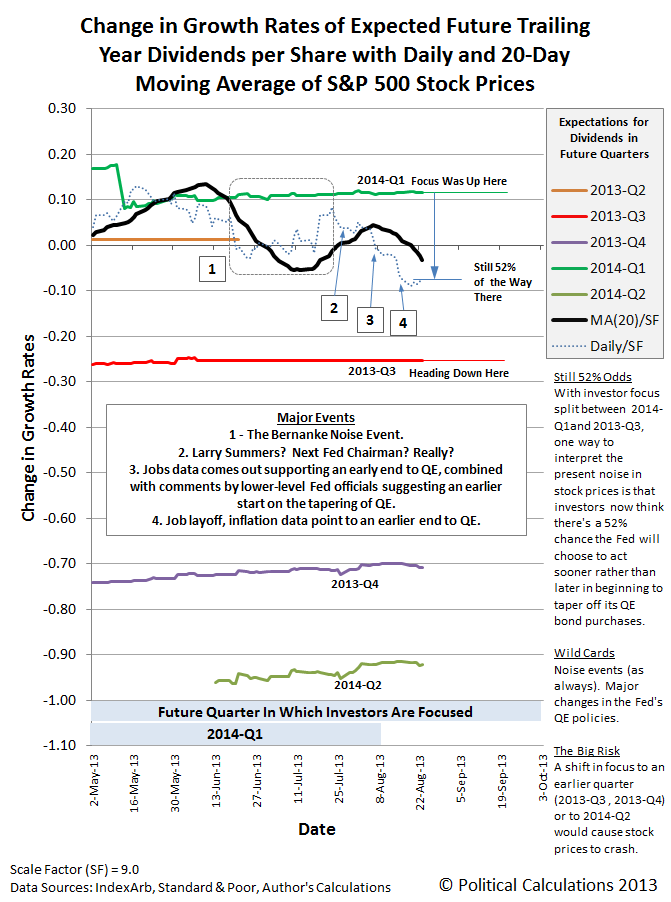
Change in Growth Rates of Expected Future Trailing Year Dividends per Share with Daily and 20-Day Moving Average of S&P 500 Stock Prices, through 23 August 2013

The biggest market-driving news of the week was the release of the notes from the Fed's 31 July 2013 meeting on Wednesday, 21 August 2013. And because they didn't provide any greater clarity for when the Fed might begin slowing the purchases of U.S. Treasuries and mortgage-backed securities that make up its current quantitative easing scheme, the change in the growth rate of stock prices remained stuck about halfway between the future associated with an earlier slowdown (2013-Q3) and the future associated with a later slowdown (2014-Q1).

It's almost as if the whole last week never happened!

Speaking of the split in the consensus for when the Fed's current QE program will begin to draw down, we wonder if the split in the consensus of the Federal Reserve's Open Market Committee is the same as the split we observe in the expectations for these two potential futures.

There was one item in last week's news that we found noteworthy. It seems an economist from Princeton University has arrived at the same conclusion about the role of the Fed in creating the market turbulence we've seen this summer that we did just a day after the event in question, although it took them over two months to reach that same conclusion and communicate it to Fed officials.

JACKSON HOLE, Wyo.—The Federal Reserve believes that providing clear guidance about the likely future course of its policies make them more effective in boosting the economy, while helping to tamp down on market volatility and uncertainty.

That may not be so, said a paper presented here Saturday by Jean-Pierre Landau of Princeton University at the research conference hosted by the Federal Reserve Bank of Kansas City.

Over the last year, the Fed has been buying $85 billion a month of bonds in an effort to lower long-term interest rates, hoping that will spur growth and lower unemployment. Fed officials have been warning for months since May that they could start scaling back the program if the economy continues to improve as they expect.

The problem for the Fed is that as its policy makers have tried to prepare markets for this shift, they've generated considerable market volatility, in part driving up bond yields and boosting borrowing costs.

But the best part is when the Princeton economist discovers the role of what we've long described as "noise events" in affecting markets:

Mr. Landau lays a lot of the blame for the bond-market turbulence on the Fed itself. The paper notes that current Fed guidance on the policy outlook eliminates the cost of leverage, and creates "strong incentives" to increase and even overextend investment exposures.

In turn, "this makes financial intermediaries very sensitive to 'news,'" whatever that may be, he wrote. In this case, the catalyst for the market tumult is the Fed's statements about possibly scaling back the bond program this year. Once that view was conveyed to markets, it drove a big shift in market positions, to a degree that was very surprising to many observers.

But perhaps not so surprising if you know what expectations for things like stock prices are associated with different points of time in the future. And as we're emphasizing today, for the current "market tumult", it's really just a matter of determining how split investors are between the outlooks that apply for each of those alternative futures.

We'll see how long it takes Princeton's economics department to catch up to that realization. Our guess though is that Princeton's physics department may beat them to it, since this is, after all, the financial equivalent of the many-worlds variant of Schrödinger's Cat experiment....

Previously on Political Calculations

We had looked forward to a boring summer. Instead, we've found ourselves providing the following observations and near real-time analysis of the economic story of the summer, to which the economics department at Princeton University would appear to only just be beginning to catch on....

  • The World Investors and the Fed Live In Now - Our snapshot of the market right before the event, in which we note that investor concern about the future of QE was growing and remark that there will be a market reaction in response to the outcome of the Fed's two-day meeting later that week.

  • The Bernanke Noise Event - as the Summer of 2013 shall ever be known to investors....

  • Now Is It Time to Sell? - according to statistics, a quaint branch of mathematics that only works to describe how stock prices vary with respect to their trend when order is present in the market. The problem with it is that the market goes in and out of order, so it's periodically pretty useless....

  • The Fed's Real QE Mistake: Timing - We explain how Bernanke really screwed up.

  • Now What Will You Do? - the statistical line is crossed! We look at everything that we see screaming "sell", without actually saying it's time to sell.

  • The Fed Attempts to Walk It Back - we anticipate how the Fed will respond to Bernanke's error, and we determine if it will work.

  • The GDP Multiplier for QE - Not about investing, at all! Instead, we explain why sustaining QE at current levels is so important to the U.S. economy at present.

  • "Never Bet Against the Fed" - we visually illustrate that the Fed's response to repairing the damage from Chairman Bernanke's blunder is working and recap why fears of stock market doom, despite signals to the contrary, were really overblown.

  • Bernanke Closes the Gap - we mark the end of the Bernanke Noise Event.

  • The Noise of Summers - we note the beginning of a new negative noise event....

  • The S&P 500 Hits 1700 A Month Late - Finally, after all that noise!

  • The Fed's Minions Shoot Themselves in the Foot - we discuss the role of new data and comments by Fed officials in forcing stock prices off the pace the Fed had previously preferred.

  • How the Timing of the Tapering Is Driving Stock Prices - we apply the kind of analysis that we invented to explain why the market would appear to be split between two very different futures.

The Kind of Analysis That We Invented


Senin, 19 Agustus 2013

How the Timing of the Tapering Is Driving Stock Prices

Why is the prospect of the Fed acting to taper off its purchases of securities in its current Quantitative Easing (QE) program appear to be driving stock prices lower?

Keep in mind that even though the Fed's QE efforts is clearly responsible for keeping the U.S. economy out of recession following the second quarter of 2012, the reason the Fed believes it can begin taking its foot off the QE gas is because the U.S. economy would appear to be beginning to recover from its microrecession.

As far as the economy is concerned, the Fed's tapering of its bond-buying through its QE program as the economy improves is really just maintaining a status quo. If the Fed's bond-buying has been successful in keeping real economic growth rates at a stable level, then as the economy gradually becomes capable of generating its own positive growth rate, it can offset what the Fed has been doing with its QE efforts, which means that the Fed can gradually ease off the gas.

And since the Fed's tapering policy is just maintaining the status quo for economic growth rates, stock prices should not be affected, because the portion of earnings that the businesses who make up the market could reasonably anticipate should likewise be unchanged in those conditions, simply because the rate of real economic growth is not expected to significantly change.

Welcome to the Time Vortex that is the Stock Market!

But that's not how prices really work. As we're about to show you, there hasn't really been any significant change in the future expectations for the sustainable portion of future earnings (aka "dividends"). And in fact, the only thing that has changed for investors is the point in the future to which serious and influential investors are focusing their attention in setting stock prices, which is being driven by the timing for when the Fed will begin tapering its QE programs.

They had been focused on 2014-Q1, which corresponds to a future in which the tapering of QE would not be expected to begin until 2014. New information of an improving situation for the U.S. economy combined with the comments of Fed officials is forcing them to shift their attention to an earlier point in time, 2013-Q3, since that coincides to the nearest future point of time in which Fed would announce that it is beginning the tapering of its QE program.

As it happens, those future quarters have different expectations for changes in the year-over-year growth rate of dividends that will be earned in them, which is what sets the fundamental pace of change in the growth rate of stock prices. And that difference in expectations at these discrete points of time in the future is what is driving stock prices today.

All these things we just described is visualized in our chart below. Mind the comments in the margin, because we believe can use what we know to measure the degree to which the forward-looking focus of investors is currently split in the stock market:

Changes in the Growth Rates of Trailing Year Dividends per Share with the Daily and 20-Day Moving Average of S&P 500 Stock Prices, through 16 August 2013

Notice in the chart above that the level for the acceleration of dividends for both 2013-Q3 and 2014-Q1 has been steady for weeks. That is the confirmation that what publicly-traded companies reasonably expect to earn in these quarters is unchanged.

But the acceleration of stock prices is changing from pacing the expectations associated with 2014-Q1 toward the expectations associated with 2013-Q3. Through 16 August 2013, they've covered 52% of the distance between them.

Put another way, that's an indication that the market currently now placing a 52% probability that the tapering of QE will begin in 2013-Q3 rather than in 2014-Q4. If it helps put the recent decline in stock prices into proper perspective, what having investors 100% fully focused on 2013-Q3 would mean for stock prices is an S&P 500 potentially falling to around the 1500 level in September 2013.

Of course, the good news in that is that the much more positive alternative future for stock prices of 2014-Q1 would still be in the future. Investors would be able to re-shift their focus back to this point of time in the future, which would correspond to a major rally in stock prices.

If the Fed had instead indicated that the tapering of QE wouldn't begin until then, we could be enjoying that rally today. But apparently, the Fed's minions had other plans....

Previously on Political Calculations

Unless it becomes relevant as events develop, this is probably the last time that we'll feature the following chain of analysis in considering the major market drivers this summer. We know we said that last week, but let us know when the links below stop being immediately relevant to the current situation in the market....

Next, that electronic trail of analysis we've provided throughout the event:

Senin, 12 Agustus 2013

The Fed's Minions Shoot Themselves in the Foot

Stock Market Chaos Do you remember the Bernanke Noise Event from earlier this summer?

In a nutshell, unexpected comments from outgoing Fed Chairman Ben Bernanke at 2:42 PM EDT on 19 June 2013 caused stock prices to fall, as he indicated that the Fed could begin tapering off its purchases of both Mortgage Backed Securities and U.S. Treasuries, which it has been doing as part of its current quantitative easing programs. Because those quantitative easing programs have been the only thing keeping the U.S. economy out of a full-fledged recession since September 2012, investors reacted negatively to the news, sending stock prices sharply lower.

The Federal Reserve then spent the next month attempting to repair the damage. And they succeeded.

Sure, the White House mucked things up a bit in suggesting that Larry Summers was President Obama's leading choice to be the next Fed Chairman, but that was a relatively minor noise event, and stock prices soon recovered to new highs.

And then, last Wednesday, 6 August 2013, at 10:32 AM EDT, stock prices began to fall once again in response to a new noise event. Since we've long established that it takes stock prices just two to four minutes to respond to the reactions of human traders when unexpected news hits, that would put the event window for the release of the news driving stock prices at that time somewhere between 10:28 AM and 10:30 AM EDT.

And as it happens, there was only one noise event that occurred during that limited period of time that had the potential to prompt such a negative reaction for traders: a story from Reuters noting that the ratio of unemployed individuals to job openings had declined to a four year low.

Number of unemployed persons per job opening, seasonally adjusted - Source: Department of Labor, JOLTS survey, June 2013

That's exactly the kind of news to which investors would react negatively, because the Fed has been saying for some time that improvements in the U.S.' employment situation like this would set the timing for when they would begin tapering off their QE efforts. And having seen the effects of the Fed's terminations of its previous QE programs, there's good reason for investors to have a negative perception, especially if there are any indications that doing so would be premature. Again.

So when 10:35 AM EDT rolled around and the WSJ's blog posted the news of Atlanta Fed President Dennis Lockhart's interview from the previous day that suggested that the Fed would begin tapering off its QE efforts this September hit the wires, the news simply confirmed what investors had already speculated when they got the jobs news just minutes earlier. Consequently, Lockhart's comments didn't affect stock prices. At least on that day, although we suspect that the market would have responded very differently if he had indicated that there would be no tapering of the Fed's QE programs until next year.

Later in the day, Chicago Fed President, Charles Evans, added his two cents as he indicated that the Fed could begin ending its QE programs in September 2013, but left the door open as to when the actual timing might be. Bloomberg reported those comments at 1:07 PM EDT, however since his comments were fairly generic, they didn't directly move the markets on 6 August 2013.

That's not to say that their comments had no effect. They are most certainly factoring into the expectations of investors in defining the atmosphere of the market.

On Thursday, 7 August 2013, Dallas Fed President Richard Fisher also indicated that the Fed will likely begin trimming its purchases of Treasuries and Mortgage-Backed Securities in September 2013, adding to the generally negative atmosphere in the stock market, which we're now seeing play out in the form of an increasing deviation in stock prices away from the levels they should be.

You can see that in our chart below, as the change in the growth rate of daily stock prices is deviating away from the level they would be if investors were focusing on the first quarter of 2014, which they had been. Instead, their forward-looking focus is being directed to the third quarter of 2013, which is when all the Fed's minions' talk of tapering is set to begin taking place.

Change in Growth Rates of Expected Future Trailing Year Dividends per Share with Daily and 20-Day Moving Average of S&P 500 Stock Prices, as of 9 August 2013

And it's not just the stock market that is responding negatively to the prospect. Bond investors are also behaving similarly:

The lack of clarity over the Fed's plans gave investors reason to pull a record $3.27 billion out of U.S.-based funds that hold Treasuries in the latest week ended Aug. 7, data from Thomson Reuters' Lipper service showed on Thursday.

"People are looking ahead to the September FOMC meeting and the prospect that the Fed begins its long-awaited exit strategy," said Michael Sheldon, chief market strategist at RDM Financial, in Westport, Connecticut.

In a sense, the comments of the three Fed branch Presidents are working to undo all of the Federal Reserve's damage repair from earlier in the summer, and perhaps the only reason stock prices haven't fallen further as yet is because Fed Chairman Bernanke and a number of the Fed's other heavy hitters haven't yet publicly indicated that the Fed will pursue cutting back its QE programs earlier rather than later.

Don't you hate it when your minions shoot themselves (and your previous policy) in the foot?

Until the Fed's decision of when it will begin cutting back its QE programs is clearly evident, we would expect that investors will split their focus in setting stock prices between the expectations that correspond with the 2013-Q3 and 2014-Q1. Stock prices in our chart will likely fall in between the expected change in the growth rates of trailing year dividends per share for these quarters, rather than closely tracking one or the other as they might normally behave.

As time passes and it becomes clear when the Fed will actually begin its QE tapering, we would expect the acceleration of stock prices to drift toward the quarter in which it will occur. In the absence of other news that might affect stock prices, for the earlier tapering of QE, that means falling stock prices, and for the later tapering of QE, that will mean rising stock prices.

The stock market is certainly a lot noisier place than it should be.

Previously on Political Calculations

Unless it becomes relevant as events develop, this is probably the last time that we'll feature the following chain of analysis in considering the major market drivers this summer. We know we said that last week, but let us know when the links below stop being immediately relevant to the current situation in the market....

Next, that electronic trail of analysis we've provided throughout the event:

  • The World Investors and the Fed Live In Now - Our snapshot of the market right before the event, in which we note that investor concern about the future of QE was growing and remark that there will be a market reaction in response to the outcome of the Fed's two-day meeting later that week.

  • The Bernanke Noise Event - as the Summer of 2013 shall ever be known to investors....

  • Now Is It Time to Sell? - according to statistics, a quaint branch of mathematics that only works to describe how stock prices vary with respect to their trend when order is present in the market. The problem with it is that the market goes in and out of order, so it's periodically pretty useless....

  • The Fed's Real QE Mistake: Timing - We explain how Bernanke really screwed up.

  • Now What Will You Do? - the statistical line is crossed! We look at everything that we see screaming "sell", without actually saying it's time to sell.

  • The Fed Attempts to Walk It Back - we anticipate how the Fed will respond to Bernanke's error, and we determine if it will work.

  • The GDP Multiplier for QE - Not about investing, at all! Instead, we explain why sustaining QE at current levels is so important to the U.S. economy at present.

  • "Never Bet Against the Fed" - we visually illustrate that the Fed's response to repairing the damage from Chairman Bernanke's blunder is working and recap why fears of stock market doom, despite signals to the contrary, were really overblown.

  • Bernanke Closes the Gap - we mark the end of the Bernanke Noise Event.

  • The Noise of Summers - we note the beginning of a new negative noise event....

  • The S&P 500 Hits 1700 A Month Late - Finally, after all that noise!

Senin, 05 Agustus 2013

S&P 500 Hits 1700 A Month Late

On 1 August 2013, the S&P 500 closed above 1700 for the first time in its history.

That was almost exactly one month later than it should have. Let's revisit one of our now rare public predictions for stock prices, from back on 10 June 2013:

Overall, it was a really boring week, but at least it set up a fun, seeming paradox for our favorite chart. Given the nature of how the moving average of the change in the growth rate for stock prices works, we'll soon see the 20-day moving average for the S&P 500 top out then fall back toward the green line (where it really wants to be), even as the value of the S&P 500 itself rises.

In the relative absence of noise in the market, that would create the potential for the S&P 500 to reach 1700 before the end of June 2013.

But then, noise is always present in the market. It's its volume that's what's random and unpredictable!

A little something we like to call The Bernanke Noise Event intervened in that forecast for the future, throwing the market off track for a whole month, the recovery from which was then drug out a little longer by a poorly considered trial balloon put out by the White House proposing Larry Summers as the leading candidate to be nominated to run the Fed after Ben Bernanke's current term expires in January 2014.

But that new noise began to dissipate when the White House gauged the market's negative reaction and began to float the name of an alternative candidate on Wednesday, 31 July 2013, as the Fed also continued its efforts to repair the damage done by Bernanke back on 19 June 2013. By the next day, enough of the noise of Summers had decreased to allow the S&P 500 to finally close above the 1700 mark.

The chart below shows where we're at today. Mind the comments in our chart above and note the differences from previous versions (hey, if the Fed's Open Market Committee can get by on tweaking the otherwise same statement from meeting to meeting, so should we be able to get away with doing the same thing on our S&P 500 stock prices and dividends per share acceleration chart!)

Change in Growth Rates of Expected Future Trailing Year Dividends per Share with Daily and 20-Day Moving Average of S&P 500 Stock Prices through 2 August 2013, with Dividend Futures through 5 August 2013

Previously on Political Calculations

Unless it becomes relevant as events develop, this is probably the last time that we'll feature the following chain of analysis in considering the major market drivers this summer.

Next, that electronic trail of analysis we've provided throughout the event:

  • The World Investors and the Fed Live In Now - Our snapshot of the market right before the event, in which we note that investor concern about the future of QE was growing and remark that there will be a market reaction in response to the outcome of the Fed's two-day meeting later that week.

  • The Bernanke Noise Event - as the Summer of 2013 shall ever be known to investors....

  • Now Is It Time to Sell? - according to statistics, a quaint branch of mathematics that only works to describe how stock prices vary with respect to their trend when order is present in the market. The problem with it is that the market goes in and out of order, so it's periodically pretty useless....

  • The Fed's Real QE Mistake: Timing - We explain how Bernanke really screwed up.

  • Now What Will You Do? - the statistical line is crossed! We look at everything that we see screaming "sell", without actually saying it's time to sell.

  • The Fed Attempts to Walk It Back - we anticipate how the Fed will respond to Bernanke's error, and we determine if it will work.

  • The GDP Multiplier for QE - Not about investing, at all! Instead, we explain why sustaining QE at current levels is so important to the U.S. economy at present.

  • "Never Bet Against the Fed" - we visually illustrate that the Fed's response to repairing the damage from Chairman Bernanke's blunder is working and recap why fears of stock market doom, despite signals to the contrary, were really overblown.

  • Bernanke Closes the Gap - we mark the end of the Bernanke Noise Event.

  • The Noise of Summers - we note the beginning of a new negative noise event....

Senin, 29 Juli 2013

The Noise of Summers

Last week, we declared the end of the Bernanke Noise Event - that brief eruption of uncertainty that sent stock prices falling after some poorly chosen comments on the part of Fed Chairman Ben Bernanke regarding the timing of when the Fed would begin tapering off its direct injection of money into the U.S. economy. The Fed had spent the next several weeks doing damage control and had finally set things close to right (see chart below).

But then somebody at the White House, perhaps upset at seeing the impact that Bernanke and various members of the Fed had upon the markets with just their words, decided that they needed have their own negative noise event too. Which they would appear to have launched by floating a trial balloon proposing that Larry Summers, the former Obama economic adviser previously best known for sleeping through White House meetings, who is perhaps now becoming better known for apparently neither understanding nor believing in the kind of successful monetary policy that has been keeping the U.S. economy out of a full-fledged recession since September 2012, was President Obama's leading choice to replace Ben Bernanke after his term as Fed Chair ends in January 2014.

Our chart below tracks how investors have reacted to the news:

Change in Growth Rates of Expected Future Trailing Year Dividends per Share with Daily and 20-Day Moving Average of S&P 500 Stock Prices through 26 July 2013

Right now, given the fundamentals of how stock prices work, stock prices should be rising as the change in the growth rate of stock prices should be keeping pace with the level indicated by the currently expected change in the growth rate of their underlying dividends per share for 2014-Q1, which is where the Fed succeeded in restoring the forward-looking focus of investors by the end of the Bernanke Noise Event.

Instead, stock prices are tracking mostly sideways in response to the uncertainty provided by the White House's new negative noise event, which we see in the form of a negative impulse for the daily track of the acceleration of stock prices, as investors are reacting negatively to the prospect.

Just hope that the trial balloon pops. The alternative futures available for investors to focus upon aren't anywhere near as good as that described by the acceleration of dividends expected for 2014-Q1.

Previously on Political Calculations

If you're just discovering our brand of analysis now, here's a good part of the electronic trail for how we got to this point! First up, the basic theory we've developed and where we get our data:

Next, that electronic trail of analysis we've provided throughout the event:

  • The World Investors and the Fed Live In Now - Our snapshot of the market right before the event, in which we note that investor concern about the future of QE was growing and remark that there will be a market reaction in response to the outcome of the Fed's two-day meeting later that week.

  • The Bernanke Noise Event - as the Summer of 2013 shall ever be known to investors....

  • Now Is It Time to Sell? - according to statistics, a quaint branch of mathematics that only works to describe how stock prices vary with respect to their trend when order is present in the market. The problem with it is that the market goes in and out of order, so it's periodically pretty useless....

  • The Fed's Real QE Mistake: Timing - We explain how Bernanke really screwed up.

  • Now What Will You Do? - the statistical line is crossed! We look at everything that we see screaming "sell", without actually saying it's time to sell.

  • The Fed Attempts to Walk It Back - we anticipate how the Fed will respond to Bernanke's error, and we determine if it will work.

  • The GDP Multiplier for QE - Not about investing, at all! Instead, we explain why sustaining QE at current levels is so important to the U.S. economy at present.

  • "Never Bet Against the Fed" - we visually illustrate that the Fed's response to repairing the damage from Chairman Bernanke's blunder is working and recap why fears of stock market doom, despite signals to the contrary, were really overblown.

  • Bernanke Closes the Gap - we mark the end of the Bernanke Noise Event.

  • The Noise of Summers - this article, as it appears on our own site, with that chart that the various sites that simply republish our RSS news feed may not have included!

We tossed the last link in because we're well aware that the vast majority of our readers encounter our articles elsewhere on the web! Come and visit us, if for no other reason than it's the one place on the web where our work appears, and in the case of the tools we develop, works, just about exactly as we intended!

Senin, 22 Juli 2013

Bernanke Closes the Gap

The stock market noise event that began with an unfortunately statement made by Federal Reserve Chairman Ben Bernanke back on Wednesday, 19 June 2013 at 2:42 PM Eastern Daylight Time is essentially over.

We've chronicled the event from the beginning, as the S&P 500 first first lost some 4.8% of its closing value on 18 June 2013 in just four trading days, before taking another eleven trading days to recover to just over that level, to finally get to the effective conclusion of the noise event another seven trading days later!

What marked the end of the event was the conclusion of Chairman Bernanke's previously scheduled two days of testimony before the U.S. Congress, in which the Chairman was very careful to keep on the Fed's damage control message that the beginning of the end of its latest programs of quantitative easing was not imminent, and would be very unlikely before the end of 2013. Investors reacted by more completely shifting their forward-looking focus to the first quarter of 2014 in setting stock prices, which we can observe in our chart below:

Change in the Growth Rates of Expected Future Trailing Year Dividends per Share with the Daily and 20-Day Moving Average of S&P 500 Stock Prices

In our chart, we see that the change in the growth rate of daily stock prices (indicated by the dotted blue line) rapidly closed the gap with the level indicated by the year-over-year change in the expected growth rate of trailing year dividends per share for the first quarter of 2014 (indicated by the solid green line). With that level representing where investors are now focused, it is now well within the typical range of variation that we observe when the stock market is characterized by relatively low levels of noise.

What this means is that the Fed has been successful in re-shifting the forward-looking focus of investors back to the level of expectations associated with the future quarter of 2014-Q1.

In the absence of a new noise event, we would anticipate that the acceleration for stock prices will converge with and bounce around this level. The good news is that will mean generally rising stock prices.

The bad news is that noise is always present in the stock market - only its source and volume ever changes!

On a closing note, we'll observe that if nothing else, Ben Bernanke's second term in charge of the Fed is ending as it began, with a noise event that only arose as a direct result of his status as the Chairman of the Federal Reserve. Let's face it - he certainly wouldn't have anywhere near the same impact on markets if he were just a tenured professor at the second best university in New Jersey.

There's some symmetry there to appreciate, but if we're being honest, we're hoping that the next Fed Chair won't be so damned noisy in their comings and goings.

Previously on Political Calculations

If you're just discovering our brand of analysis now, here's a good part of the electronic trail for how we got to this point! First up, the basic theory we've developed and where we get our data:

Next, that electronic trail of analysis we've provided throughout the event:

  • The World Investors and the Fed Live In Now - Our snapshot of the market right before the event, in which we note that investor concern about the future of QE was growing and remark that there will be a market reaction in response to the outcome of the Fed's two-day meeting later that week.

  • The Bernanke Noise Event - as the Summer of 2013 shall ever be known to investors....

  • Now Is It Time to Sell? - according to statistics, a quaint branch of mathematics that only works to describe how stock prices vary with respect to their trend when order is present in the market. The problem with it is that the market goes in and out of order, so it's periodically pretty useless....

  • The Fed's Real QE Mistake: Timing - We explain how Bernanke really screwed up.

  • Now What Will You Do? - the statistical line is crossed! We look at everything that we see screaming "sell", without actually saying it's time to sell.

  • The Fed Attempts to Walk It Back - we anticipate how the Fed will respond to Bernanke's error, and we determine if it will work.

  • The GDP Multiplier for QE - Not about investing, at all! Instead, we explain why sustaining QE at current levels is so important to the U.S. economy at present.

  • "Never Bet Against the Fed" - we visually illustrate that the Fed's response to repairing the damage from Chairman Bernanke's blunder is working and recap why fears of stock market doom, despite signals to the contrary, were really overblown.

  • Bernanke Closes the Gap - the article you're reading right now, as it appears on our own site, just as we intended it!

We tossed the last link in because we're well aware that the vast majority of our readers encounter our articles elsewhere on the web! Come and visit us, if for no other reason than it's the one place on the web where our work appears, and in the case of the tools we develop, works, just about exactly as we intended!