Rabu, 13 Juni 2012

Paper, Plastic or Cloth: Which Bag is Best for the Environment?

Which is the most earth-friendly: paper bags, plastic bags or cloth bags?

The answer to the question depends upon whether or not you really believe in science, because as they say in certain environmental activist circles, the "science is settled"! Here's the summary description of the bag found to be the best for the environment, which is defined as being the bag with the least negative impact upon the environment, as found in a very recent and thorough study on the topic:

The conventional HDPE bag had the lowest environmental impacts of the lightweight bags in eight of the nine impact categories. The bag performed well because it was the lightest bag considered. The lifecycle impact of the bag was dictated by raw material extraction and bag production, with the use of Chinese grid electricity significantly affecting the acidification and ecotoxicity of the bag.

Yes, the convential High-Density Polyethylene (HDPE) (aka "plastic") bag had the least impact upon the environment of all the bags considered in the study, which considered a number of bags made from different plastics, as well as both paper and cotton-based materials!

But that's only considering using each type of bag just once. For many eco-oriented people, the whole point is to reuse other kinds of bags to counteract the perceived environmental hazards posed by the conventional plastic bag.

Fortunately, the study revealed how many times the alternatives to the conventional plastic bag would have to be reused to overcome their own negative impacts to the environment:

Table 8.1 The amount of primary use required to take reusable bags below the global warming potential of HDPE bags with and without secondary reuse.

Here, we find that if a consumer only uses a conventional HDPE plastic bag just once (say to carry their groceries home before throwing the bag away), a paper bag would have to be reused 3 times, a heavy-duty plastic bag made from Low-Density Polyethylene (LDPE) would have to be used 4 times, a plastic "bag-for-life" made of non-woven Polypropylene (PP) would have to be used 11 times, and a cotton (or canvas) bag would need to be re-used 131 times!

The study reports that a canvas bag is expected to last for 52 trips (Table A.3.1). With that as a reference, a cotton/cloth canvas bag user does over twice the damage to the environment that a plastic bag using grocery shopper who throws away every plastic bag they get immediately after each shopping trip, as they will likely have to replace their more environmentally-destructive bag at least once long before they reach 131 uses!

However, if a consumer reuses 100% of their conventional HDPE plastic bags (say as trash bags), the number of uses needed for the other bags to have a lesser environmental impact than the conventional HDPE plastic bag rises by a factor of anywhere from 2.2 to 2.5, which we see in the table above. For example, that re-usable canvas bag would need to be used at least 327 times to be less damaging to the environment!

Which makes the eco-friendly canvas bag user over six times as destructive to the environment as the conventional consumer who simply re-uses all the plastic bags they get from the grocery store just once.

If only those anti-plastic bag advocates cared more about the environment....


Reference

Edwards, Chris and Fry, Jonna Meyhoff. Life Cycle Assessment of Supermarket Carrier Bags. Report SC030148. Environment Agency.

Selasa, 12 Juni 2012

Austerity, Done Right, Part 2

How has the small nation of Estonia been able to turn its fiscal and economic situation around so effectively?

After all, Estonia had been pretty badly beaten up in the world's economic turmoil in the years since 2007, seeing its GDP per capita fall from a high of $17,810.60 (in terms of nominal, current year U.S. dollars) to $14,137.60 by 2010, an overall percentage decline of 20.6%.

But in 2011, Estonia's GDP per capita grew by 17.3% from that low point to $16,583.40.

At the same time, the government saw its fiscal situation reverse from running a deficit of 3% of the nation's GDP in 2008 to a surplus of 1% of the nation's GDP in 2011.

Estonia Government Spending and Tax Revenue per Capita vs GDP per Capita, 2000-2011, Part 2

So what exactly did Estonia do right that neither Greece, nor Spain, nor the United States has done during that same period of time?

The answer is that the Estonians did austerity right. Instead of jacking up government spending, in the hopes of stimulating their economy or in the name of bailing out failing institutions or politically-connected businesses, the Estonian government kept their spending under control. They acted to keep their spending in line with their actual tax collections, which in turn, has kept the nation on a sound financial footing as they succeeded in avoiding huge increases in their national debt.

As we've seen previously, huge increases in a country's national debt can act as a huge brake on a nation's economy. Avoiding large increases in the country's national debt has therefore helped boost Estonia's economic recovery.

At the same time, the Estonian government increased tax rates, but unlike other nations, and from the perspective of fiscal policy (usually, it's not a great idea to hike taxes during a recession), they raised the right ones and kept the size of the tax increases relatively small.

Here, instead of foolishly focusing on trying to extract an ever larger percentage of the incomes earned by the most successful Estonians, the people whose economic activities can disproportionately affect a significant share of the nation's economy, the Estonian government implemented a very broad-based tax increase through its Value-Added Tax, which spread the pain of the tax increase across the nation's entire population, as it increased its VAT rate from 18 to 20%.

At the same time, Estonia acted to ensure that its flat income tax rate would remain stable and not rise. By doing so, Estonia preserved its incentives for *all* Estonians to do the things that can generate more income. Collectively, the things that people can do to generate more income are the things that can significantly grow a nation's economy.

With that certainty in policy, the nation's economic fortunes turned toward the positive in 2010 and boomed in 2011. We project that in 2012, the Estonian economy will surpass its 2008 performance, marking a full recovery - despite the ongoing overall economic turmoil currently affecting Europe.

In fact, the economy has turned around so strongly that the Estonian government will cut its flat income tax rate from 21% to 20% in 2015 - relieving a good portion of the additional tax burden it placed on Estonians during its deepest recession years.

From a fiscal stability perspective for the Estonian government, that makes sense. One of the key lessons learned among the individual states in the U.S. during the past several years is that sales taxes (which a VAT resembles) are more stable than either personal income taxes and especially corporate income taxes. Estonia's public finances will be on an even more sound footing going forward as a result.

Quite possibly, it will be yet another lesson that the nations of the world can learn from Estonia.

Previously on Political Calculations

Senin, 11 Juni 2012

Rabbit Industry Groups


c. Other  
Pet

- Market meat
- Fancy
- Pet
- Limited home consumption
Angora Wool
- Home collection
- Hand spun or sold raw
- Finished craft products
                                                                             4H  
-Under $500 in wholesale sales
-Unintentional breeding
- Shelter/Humane Society (surrendered or unintentional breeding)

-Licensed sales of breeding or show stock when >$500
-Culls to pet, meat, 4H and feeder markets
- Unlimited direct sales to pet owners

Hobby Meat
-Custom slaughter
- State inspected processing plants
- Home kill and direct sales
- Home consumption

-Wholesale activities licensed under the Animal Welfare Act
-Unlimited direct sales to pet owners

-USDA and State inspected plants
-Grocery and restaurant sales

-Medical research
-Educational research


Laboratory


b. Commercial Breeders 
Meat


Pet

                                                                                
a. Hobby

Show/Fancy

Introduction to the Domestic Rabbit

The European or Old World Rabbit

While the U.S. has a number of native rabbit species, the term domesticated rabbit refers to the Old World rabbit
 O. cuniculus population. Over time the rabbits developed resistance to the disease, and currently RHD is used to control the pest rabbit population in Australia and New Zealand (Fenner and Fantini, 1999). RHD was first identified in the U.S. in 2000. RHD has the potential to affect both the commercial and pet rabbit populations in the U.S.
The Old World rabbit is native to Western Europe and Northwest Africa. The Old World rabbit was spread to new areas by human exploration and exists today on every continent except Antarctica. A rabbit's fur makes them well suited for cold climates and they can manage in warm regions as well. Where rabbits have no natural predators they are considered pests, since they eat agricultural crops and compete with native species for forage. Rabbits were introduced to New Zealand and Australia, where the lack of natural predators allowed their population to grow unchecked.

Rabbit domestication began when the Phoenicians reached Spain around 1000 BC. Breeding was conducted either in hutches or in walled warrens and eventually rabbit rearing became popular in cities. Rabbit meat production became relatively standardized in the late nineteenth century, and improvements continued in the twentieth century. Early advances in rabbit production flowed from the U.S. to Europe. After 1950 European production improvements advanced more quickly as demand for rabbit in the U.S. was replaced by increasing beef demand. Today, Italy and France maintain a comparatively high demand for rabbit meat, and are leaders in rabbit production.

Rabbits are susceptible to a number of diseases, including myxamatosis, tularemia, pasteurellosis, coccidiosis, enterotoxemia, encehpalitozoonosis and RHD. Tularemia is a zoonoses that is often contracted when wild rabbits are hunted for game. Myxamatosis was once used by Australia to control their wild
Oryctolagus cuniculus. O. cuniculus was introduced to North America by early settlers who used the rabbits as a source of food and furs. Rabbits, hares and pikas are members of the Leporidae family, commonly known as lagomorphs. Native North American lagomorphs include the cottontail (Sylvilagus audubonii) and jack rabbits (Lepus). Jackrabbits are actually hares and give birth to fully furred kits with open eyes that can hop shortly after birth. Rabbits give birth to furless, deaf and blind kits that rely on their mothers milk at birth. Wild rabbits are herbivorous and re-ingest waste, cecals, to retain as much nutrient value as possible from their diet. Wild rabbits do not have very long lives (less than two years) and they reproduce quickly with litters of five to six kits.

Austerity, Done Right, Part 1

We have to admit that we're pretty amused by the latest economic dispute to break out in the world of social media involving a Nobel-prize winning economist, Paul Krugman, and the President of Estonia, Toomas Hendrik Ilves. The Los Angeles Times reports:

Twitter went atwitter Wednesday over a somewhat surprising spat: The President of Estonia apparently slamming New York Times columnist Paul Krugman as "smug, overbearing & patronizing."

Estonia enjoys a budget surplus after enduring harsh austerity measures, which have been deeply unpopular across the Eurozone. Wednesday, Krugman argued in a short blog that Estonia, "the poster child for austerity defenders," had only achieved an incomplete recovery.

"Better than no recovery at all, obviously -- but this is what passes for economic triumph?" he concluded.

In response, the Twitter account used by Estonian President Toomas Hendrik Ilves snapped that Krugman was indulging in "smug & snide gloating" at Estonians' expense. One tweet dropped a profane word to sarcastically say Eastern Europeans could be insulted because "their English is bad, won't respond & actually do what they've agreed to & reelect govts that are responsible."

So what of Estonia's austerity? Has it really put the nation on a fiscally-sustainable path? Are Estonians economically benefitting from the steps their government has taken in recent years?

To answer that question, we'll employ the same kind of analysis that we've already applied to the economic situations of Greece, Spain and the United States. Our chart below taps the data on Estonia's governments spending and tax collections per capita from 2000 through 2011 from Eurostat, presenting them against the country's GDP per capita, as recorded in the IMF's April 2012 World Economic Outlook (as presented by the wonderful data site Knoema) for each of those years:

Estonia Government Spending and Tax Revenue per Capita vs GDP per Capita, 2000-2011, Part 1

Note: All values in the chart above and discussed below are given in terms of nominal (non-inflation-adjusted) U.S. dollars, rather than inflation-adjusted or Purchasing Power Parity-adjusted terms, because these nominal values corresponds to the amounts of GDP, tax collections or government spending per capita that people, including government officials, actually see in real time.

Looking at the chart, we find that as a percentage of GDP, Estonia's total tax collections were remarkably stable for the years from 2000 through 2008, as the government successfully collected approximately 36.1% of the nation's GDP, less some $66.63 per capita in each year. During that time, we also observe that Estonia regularly maintained either a nearly balanced budget or a budgetary surplus.

In 2008 however, the nation fell into recession, with government spending rising sharply and swinging the government's budget from surplus to deficit, even as its tax collections remained on the same trajectory it had been with respect to the nation's GDP per capita since at least the year 2000, the arbitrary starting point for our analysis.

Unlike the three other governments that we've previously considered however, Estonia's government acted to keep itself on a fiscally-viable path. In 2009, as the nation fell deeper into recession, the government cut its spending by 7.8% from the previous year.

Meanwhile, Estonia kept its income tax rates stable, but hiked its Value-Added Tax rate from 18 to 20% in July 2009.

As a result of the nation's higher Value-Added Tax rate, Estonia's tax collections per capita in 2009 were over 19% higher than would have been collected given the same level of GDP per capita for the tax rates that applied for the years from 2000 through 2008. Estonia's total tax collections fell from the previous year by just 4.8%, which is especially remarkable considering that the nation's GDP per capita fell by almost 20% during that year.

Such a large tax increase had negative effects however as the nation's economy continued to decline, with total tax collections falling 6.7% in 2010, falling much faster than the 1.4% rate at which the nation's GDP per capita declined, as the higher taxes consumed a greater share of the falling incomes of Estonians. That decrease in tax collections occurred even though the government increased its excise taxes on alcohol and tobacco products in 2010.

More significantly however, the Estonian government reduced its spending by 11.5% in that year, which put the nation much closer to being on a fiscally sound footing as the nation's downward economic trajectory began to reverse.

With the nation's economy now recovering, both the government's spending and tax collections have been rising, with spending in 2011 up by 10.4% and tax collections up by 12.4% as the Estonian government returned to running an annual budget surplus. Meanwhile, the Estonian economy grew by an astounding 17.3%.

So how was Estonia able to turn its fiscal and economic situation around so effectively?

We'll take on that question in our next post in this series!

Previously on Political Calculations

Minggu, 10 Juni 2012

Meat Rabbits News Teaching you everything you need to know about raising rabbits to survive

FRIED RABBIT MEAT.
Fried rabbit is not only quick and easy, but also delicious. Serve
these fried rabbit pieces with a thick cream gravy (use the oil you
used to fry the rabbit to give it more flavor) and homemade
buttermilk biscuits. It's a feast!

Heart of Dixie Fried Rabbit

 
  • 1 rabbit, fryer-sized, cut into pieces
  • 2 1/2 cups whole milk
  • 2 eggs, beaten
  • 2 1/2 cups flour
  • 1 black pepper
  • 1 tablespoon paprika
  • Oil for frying
 
  1. Combine milk and eggs in bowl large enough to contain rabbit pieces. Add rabbit pieces and marinate for an hour in the fridge.
  2. Combine flour, pepper and paprika in a shallow dish.
  3. Remove rabbit from milk mixture, shaking off excess, and dredge in flour mixture. Return to fridge for 15-20 minutes.
  4. Add oil to cover bottom of skillet, 1/2 inch deep. Heat to medium-high and add rabbit pieces. Using tongs, brown both sides evenly, then reduce heat to medium/medium-low. Continue to turn rabbit pieces often with tongs until cooked through, about 20-25 minutes.
Enjoy!

Jumat, 08 Juni 2012

The Best Mousetrap Ever

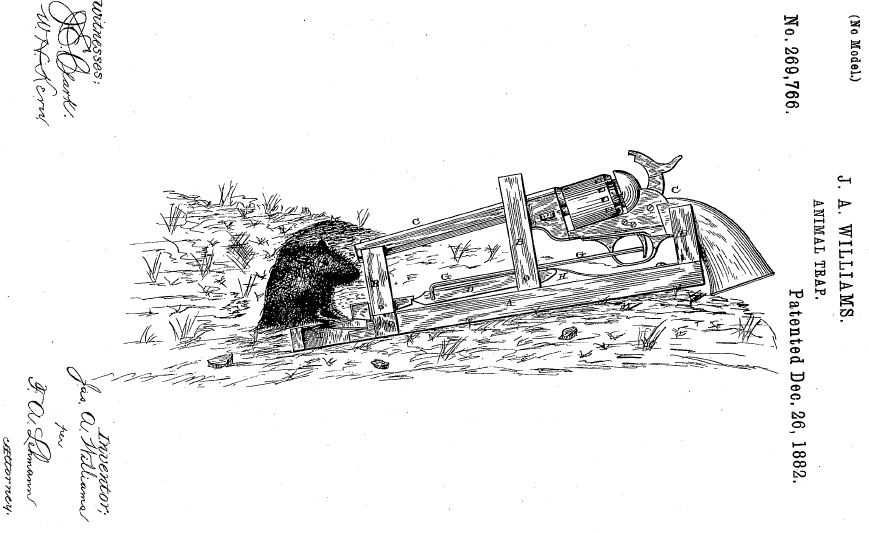
Inventors spend their lives seeking to build the proverbial better mousetrap, but we're pretty sure that the best mousetrap ever was invented by James A. Williams of Fredonia, Texas and patented on 26 December 1882:

U.S. Patent #269766

Yes, it's real and it's glorious! Quoting from the abstract for U.S. Patent #269,766 (via Google's Patent Search):

My invention relates to an improvement in animal traps; and it consists in the combination of a suitable frame upon which a revolver or pistol is secured, a treadle which is secured to the front end of this frame, and a suitable spring and levers, by which the firearm is discharged when the animal steps upon the treadle, as will be more fully described hereinafter.

The object of my invention is to provide a means by which animals which burrow in the ground can be destroyed, and which trap will give an alarm each time that it goes off, so that it can be reset.

The accompanying drawing represents the side elevation of my invention complete.

But wait, that's not all! Inventor Williams identifies another use for his invention:

This invention may also be used in connection with a door or window, so as to kill any person or thing opening the door or window to which it is attached.

James A. Williams was clearly a man with whom no person or thing should ever trifle, be they a burrowing animal, or something else. We wonder what exactly the "thing" was that his invention was meant to kill if it ever opened his door or window in Fredonia, Texas....